OC · StrataCommon property cleaning for Melbourne owners corporations and body corporates
OC · StrataCommon property cleaning for Melbourne owners corporations and body corporates
S09Floors
Strata carpet cleaning brings corridor carpet back from the grey stripe that runs from the lift to every front door. We pre-treat the traffic lanes, hot water extract level by level, and plan the drying so residents can still get home. Before quoting, we also tell you honestly what is dirt and what is wear.
CRCorridorsLBLobbies and landingsLCLift cars and mats
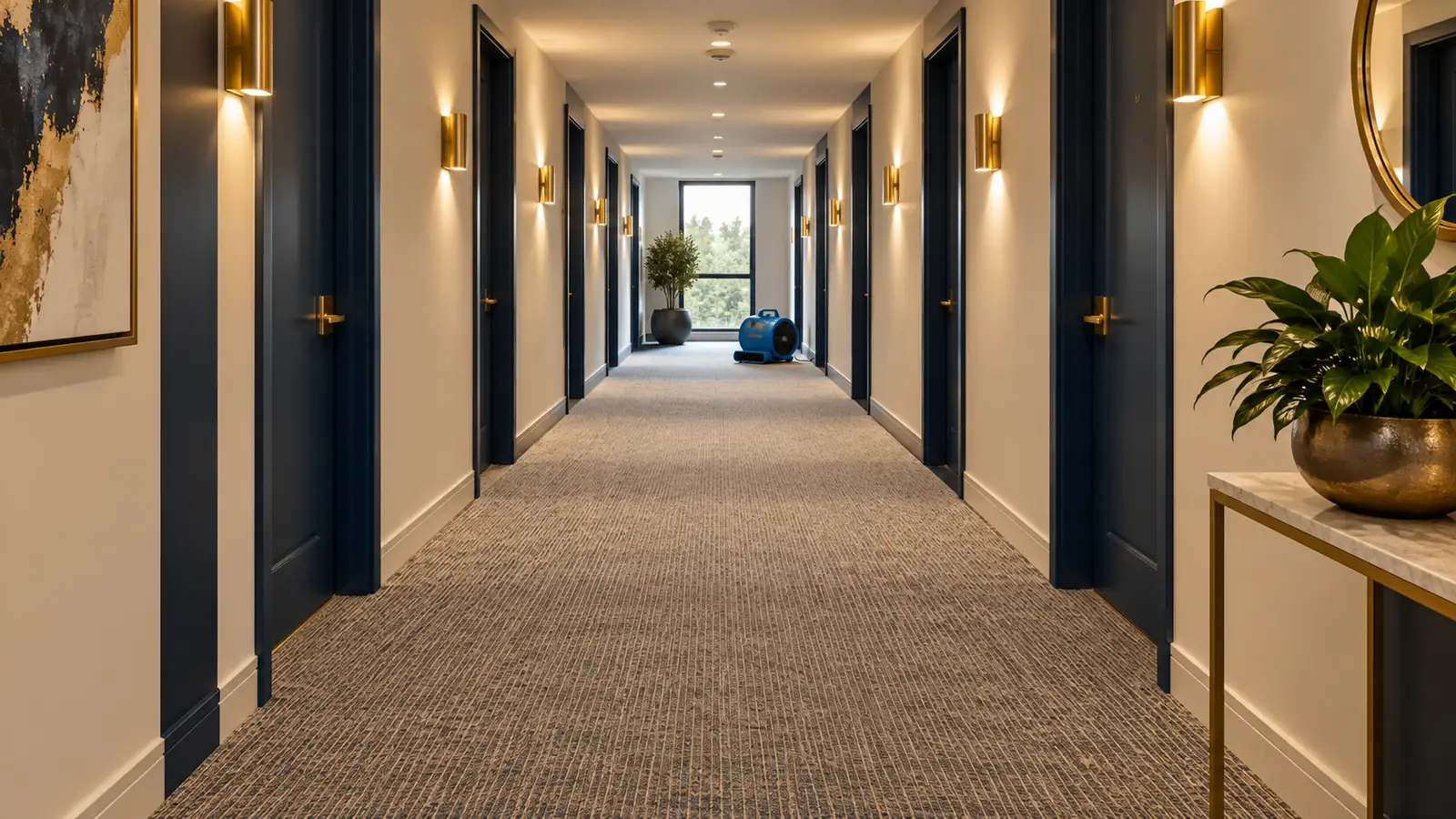
Carpeted corridors are expensive to replace and quick to look shabby, so this one is worth reading if your maintenance plan shows new carpet on the horizon. It explains why strata carpets wear the way they do, how we extract them, how corridors stay usable during the job, how to tell a stain from wear, how often extraction is worth doing and what it costs. Extraction sits in the periodic column of our strata cleaning services, with the weekly vacuum doing the everyday work in between.
01The grey stripe
Corridor carpet greys out along the traffic lane because every resident walks the same narrow path from the lift to their door. Grit from shoes cuts the fibres, oily soil sticks to them, and the lane darkens while the edges beside the skirting stay close to new. Regular strata carpet cleaning slows that process.
Vacuuming removes loose grit but not the oily film that makes fibres attract more dirt. Over a year or two the lane becomes a visible stripe, and residents start to describe the building as tired even when everything else is clean.
Lift landings and the first few metres out of the lift are always the worst, because everyone crosses them. Doors at the far ends of long corridors see far less traffic, so their carpet can look years younger than the carpet outside the lift.
Melbourne's wet winters add to it. Residents walking in from the rain, or up from a damp carpark, bring moisture and fine mud straight onto the lobby carpet and the corridor on the first level.
Cross-section of a typical corridor carpet
02Method
Hot water extraction sprays heated water and a cleaning solution into the carpet and immediately vacuums it back out, taking dissolved soil with it. Done properly, it follows a thorough dry vacuum and a traffic-lane pre-treatment, and finishes with a rinse so no sticky residue is left to attract new dirt.
A thorough vacuum first, edges included, so the extractor is not turning grit into mud.
A solution on the traffic lane and landings, given time to loosen oily soil.
Coffee, wine, gum and rust marks treated with the right product for each.
Hot water extraction, with a final rinse pass so residue does not stay behind.
Pile groomed, air movers set up, and the level signed until it is dry.
The rinse step is the one most often skipped by cheaper carpet cleaners. Shampoo left in the pile feels clean for a week, then acts like a magnet for dirt, and the lane comes back darker and faster than before. It is why some committees believe carpet cleaning makes things worse.
03Access
We clean one level at a time, start early in the day, leave a dry walkway when a corridor is long enough, and run air movers to speed drying. Residents get notice of the day their level is done, and the level is signed until the carpet is dry to walk on.
Most corridor carpets are dry enough to walk on within two to six hours, depending on the weather, the carpet and the airflow in the corridor. Humid winter days sit at the long end of that range, which is why we avoid booking carpets straight after rain.
Removalist days and parcel deliveries can undo a morning's work, so we check the building's booking calendar with the manager before fixing a date. A level that has a move scheduled that afternoon is simply moved to another day.
Lift cars with carpet are done last, either very early or late, while the lift is briefly taken out of service with the manager's agreement. Entry mats are swapped for temporary ones on the day so wet shoes do not track across newly cleaned carpet.
04Honest inspection
A stain is something added to the carpet that can often be removed. Wear is damage to the fibres themselves, such as flattening, fuzzing or colour loss, and no cleaning reverses it. We check which is which before quoting, so the committee knows what extraction will and will not change.
| What you see | Usually | What to expect |
|---|---|---|
| Grey traffic lane | Mostly soil, some wear | Lightens a lot; some texture change may remain |
| Coffee or wine spots | Stain | Most lift, especially if treated early |
| Flattened, fuzzy pile | Wear | Cleaner, but still flattened |
| Bleach or sun patches | Colour loss | Cannot be cleaned back; patch or replace |
| Dark lines at doors | Air filtration soiling | Improves with targeted treatment |
Floor coverings within a lot: Consumer Affairs Victoria, owners corporation definitions.
On the walk-through we do a small test patch in the worst area where the committee agrees. It is the quickest way to show what a full clean will achieve, and it stops anyone expecting brand-new carpet from a clean.
It also helps to know who owns which carpet. Corridor, lobby and landing carpet is common property in most schemes, so the owners corporation pays for it. Carpet inside an apartment usually belongs to that lot owner, as Consumer Affairs Victoria notes for floor coverings within a lot. Owners who want their own carpet done on the same day can book separately at their own cost.
If the carpet is near the end of its life, we say so. Sometimes the honest advice is one last clean to tidy it up before replacement, rather than a regular cycle.
05Frequency
Most apartment corridors do well with extraction once a year, on top of weekly vacuuming. Busy towers and lobbies may need it every six months, and quiet walk-up landings can stretch to every two years. The weekly vacuum does most of the work; extraction resets what vacuuming cannot reach.
The vacuum program is the foundation. Corridors vacuumed weekly, with edges and corners done by hand, keep grit from cutting the fibres and double the time between extractions. Weekly corridor vacuuming comes standard with residential strata cleaning in carpeted buildings.
In between full extractions, lift landings and the first few metres of each corridor can have a quick traffic-lane clean, which costs far less than doing a whole building. Many schemes book that at the six-month mark and the full extraction at twelve.
Winter is a good time for carpets because the outdoor jobs are on hold, but drying takes longer. Where a building runs on a yearly calendar, carpets are placed after the dusty outdoor work so grit is not walked back in, a detail handled automatically in our strata cleaning and maintenance programs.
06Pricing
Carpet cleaning is priced by the area of carpet, the number of levels, how heavily soiled the traffic lanes are and whether lift cars and mats are included. A building's first extraction may cost more if the carpet has been neglected; regular cleans after that are quicker.
Area is measured on the walk-through: corridor length and width on each level, plus lobbies and landings. Lift car carpets are priced per car, and entry mats per mat. If some levels are carpeted and others are tiled, only the carpeted areas are included.
Spot cleaning between extractions, for a spilled drink or a pet accident in a corridor, can be added to the routine visit or booked as a short call-out. The sooner a spill is treated, the more likely it is to come out completely.
Compared with replacement, extraction is inexpensive. New corridor carpet across a mid-rise building is a major line in a maintenance plan. Adding years to its life with a yearly clean is one of the better value decisions a committee can make. For how carpets fit into a whole-building figure, see strata cleaning cost.
07Planning the day
Tell us the number of carpeted levels, whether lobbies and lift cars are carpeted, and the suburb. We measure on a walk-through, test a patch if you want to see the result first, and quote a day plan that shows which level is done when.
Once the date is set, the notice for residents goes into the lifts and the manager's newsletter a week ahead. You can get a quote using the full enquiry form, which accepts photos of the worst areas. Other services we offer across the city are listed on strata cleaning Melbourne.
08Carpet questions
That and two other questions residents and committees ask most.