OC · StrataCommon property cleaning for Melbourne owners corporations and body corporates
OC · StrataCommon property cleaning for Melbourne owners corporations and body corporates
S04Waste areas
Strata bin cleaning covers the rooms, bays and chutes where a building's rubbish waits for collection. We hot wash floors and walls, wash the bins, clear the drains, clean chute doors on every level and arrange chute flushing, so the smell stops at the source instead of being covered up.
BRBasement bin roomsCHChute buildingsBBOutdoor bin bays
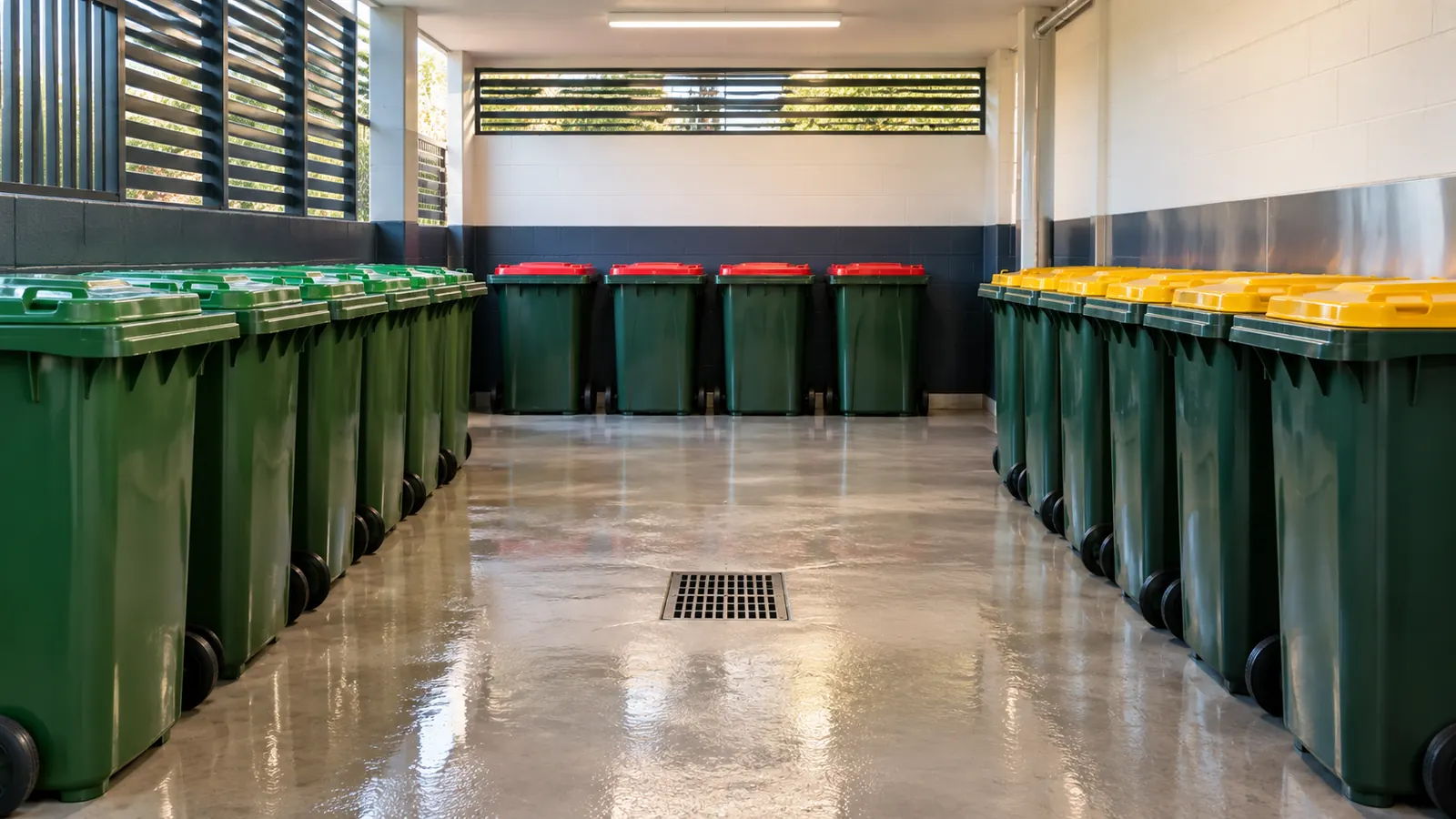
This page is for committees and managers whose bin room has become the building's running joke, and for anyone planning a new cleaning contract who wants the waste areas done properly from day one. It covers what we clean, the method, how chutes are handled, why we do not rely on air fresheners, how often each job needs doing, and what it costs. Bin rooms are one part of our wider strata cleaning services, usually booked alongside the routine clean.
01The complaint magnet
In our experience, bin rooms and chutes cause more strata complaints than any other common area because the smell travels. It rises up the chute, drifts into lift shafts and corridors, and reaches people in their own homes. Regular strata bin cleaning is the only lasting fix.
A dirty foyer annoys residents when they walk through it. A dirty bin room reaches them on level nine, with the windows shut, at dinner time. That is why committees hear about it so quickly, and why new owners raise it at their first AGM more than almost anything else.
Melbourne's weather makes it worse in bursts. A run of 35-degree days in January turns a bin room that was fine in October into a problem within a week. Food scraps, nappies and pet waste break down fast in the heat, and a slow drain or a sticky floor becomes the source of the smell long after the bins have been emptied.
The trail on the right shows how it moves. Break any link, especially the first two, and complaints drop sharply.
How the smell travels
02Method
The room is emptied, the bins are washed and set aside, then the floor, lower walls and drain are degreased and hot washed. Everything is rinsed to the floor drain, dried as far as possible, and the bins go back clean, lined up and ready for collection.
Bins rolled out, loose rubbish picked up, anything dumped photographed for the manager.
Inside and out, lids and hinges included, with a degreaser suited to food waste.
Detergent worked into the floor and the bottom metre of wall, where splashes land.
Hot water lifts fat and residue that cold water only spreads around.
Grate lifted, trap cleared, drain flushed so water and smell both move on.
Bins back in place, room photographed, anything broken reported.
Where the water goes matters. Wash-down water from a bin room carries food waste and detergent, so it belongs in a sewer-connected floor drain, never across a driveway into a stormwater pit. EPA Victoria's guidance is that everyone must prevent waste from entering stormwater drains as far as reasonably practicable. Outdoor bin bays with no sewer drain are cleaned with a wet vacuum instead of a hose.
Source: EPA Victoria, stormwater. Checked September 2026.
03Chutes
Chute doors are cleaned by our crew on every level during the routine visit. The chute itself is flushed from the top down, using a rotating spray head, hot water and detergent, by a chute cleaning specialist we book and supervise. Both are needed for a chute to stay fresh.
The hopper door on each floor is what residents touch and smell, so it gets attention far more often than the shaft. We wipe the door, the handle and the rubber seal, and clean the small floor area in front of it where drips land.
Inside the chute, residue builds slowly. Most buildings need a full flush once a quarter, more often if residents drop loose food or liquid. We coordinate the specialist's visit, give residents notice not to use the chute during the flush, and clean the discharge point and bin room straight afterwards so the job finishes clean at both ends.
If a chute keeps blocking, the report says so. That is usually a sign of oversized items or a damaged door, and the manager may want to remind residents or book a repair.
Cleaning points in a chute building
04No perfume tricks
By removing what causes them. Odour comes from residue on floors, bins, drains and chutes, and pests come for the same food. Clean those surfaces on a steady cycle and both problems shrink. Air fresheners only hide a smell for a day and can make residents think the problem is solved.
| Situation | Masking | Treating at source |
|---|---|---|
| Sticky floor | Scented spray after mopping | Degrease and hot wash, rinse to drain |
| Smelly bins | Deodoriser blocks in each bin | Bins washed inside and out on a cycle |
| Drain smell | Perfumed drain tablet | Grate lifted, trap cleared and flushed |
| Chute smell on a floor | Air freshener by the door | Door and seal cleaned, chute flushed quarterly |
We do use a deodorising product after a wash, but only on a surface that is already clean, where it has something to work with. We will not promise that a product kills a certain percentage of germs or keeps a room fresh for a set number of days. Those claims depend on too many things we do not control, such as what residents throw away and when the council truck arrives.
Pests are the same story. A clean waste area is the first line of pest control in any building. If we see droppings, cockroaches or signs of rats, we photograph them and tell the manager straight away. Baiting and spraying are for a licensed pest controller, and our wash cycle makes their treatment far more likely to last.
05Frequency
As a working default: a tidy and spill wipe on every routine visit, a full hot wash of the bin room monthly, and a chute flush quarterly. Busy buildings and hot summers move the hot wash to fortnightly or weekly. Small outdoor bin bays can often go monthly all year.
| Set-up | Hot wash | Bins washed | Chute flush |
|---|---|---|---|
| Townhouse bin bay | Monthly | Monthly | No chute |
| Walk-up, shared bin room | Monthly, fortnightly in summer | Monthly | No chute |
| Mid-rise with chute | Fortnightly | Fortnightly | Quarterly |
| Tower with chutes | Weekly | Weekly | Quarterly, or more if needed |
In between hot washes, the routine visit covers the basics: floor swept, spills wiped, bins lined up, lids closed and chute doors cleaned on each level. That light daily or weekly attention is what stops the monthly wash turning into a battle. It is part of our residential strata cleaning checklist in every apartment building.
Timing the wash matters too. The best day is straight after collection, when the bins are empty and light. We ask the manager for the council or private collection days and build the wash around them.
06Pricing
Bin room cleaning is priced by the size of the room, the number of bins, whether there is a chute and how often it is washed. Most schemes add it to the routine clean as a line on the monthly invoice, with chute flushing priced per visit.
A single walk-up bin room with six bins is a quick job. A tower basement with twenty bins, two chutes and a recycling cage takes several hours. Access matters too: a room with a sewer drain and a hot water tap is faster to wash than one where water has to be carried in.
Buildings often keep other waste in the basement next to the bin room, such as hard rubbish waiting for collection or a cardboard cage. The floor around those areas is usually cleaned under our carpark and basement cleaning routine, so the two scopes are best priced together.
For whole-building figures by scheme size, see strata cleaning cost.

What changes a bin room price
07Booking
Tell us the building type, how many bins and chutes there are, and your collection days. We look at the room, often in a short visit, then quote a wash cycle that fits around collections. A one-off deep clean can come first if the room has been neglected.
If the smell has already become a complaint, send a photo of the room and the chute door on a top floor. It usually tells us straight away whether we are dealing with the floor, the drain, the bins or the chute. To send more detail, get a quote through the full form. For everything else we clean across the city, see strata cleaning Melbourne.
08Questions
Three quick answers for committees comparing options.